Where to start ?
According to the Intergovernmental Panel on Climate Change, the planet’s average temperature has already risen by about +1.1°C to +1.2°C compared with the preindustrial era. The Paris Agreement aims to stay well below +2°C and to pursue efforts to limit warming to +1.5°C. However, based on current projections, this +1.5°C threshold could be crossed in the early 2030s.
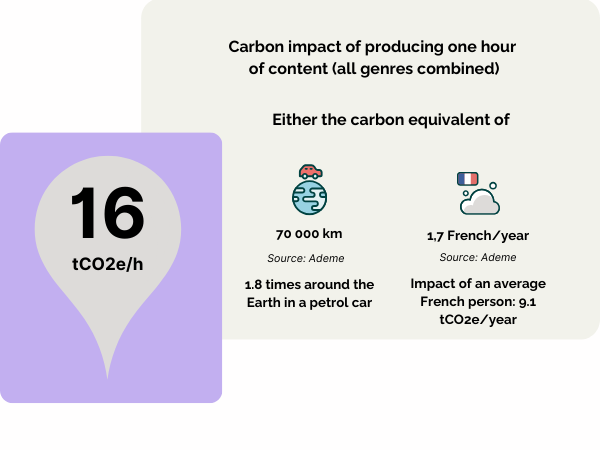
The sector currently emits 1.7 million tonnes of CO₂ per year in France and relies on numerous non-renewable resources. One hour of audiovisual programming, across all genres (fiction, documentaries, advertising, etc.), generates an average of 16 tonnes of CO₂, which is more than the annual emissions of a French citizen (approximately 10 tonnes).
Transport is the most important activity in production.
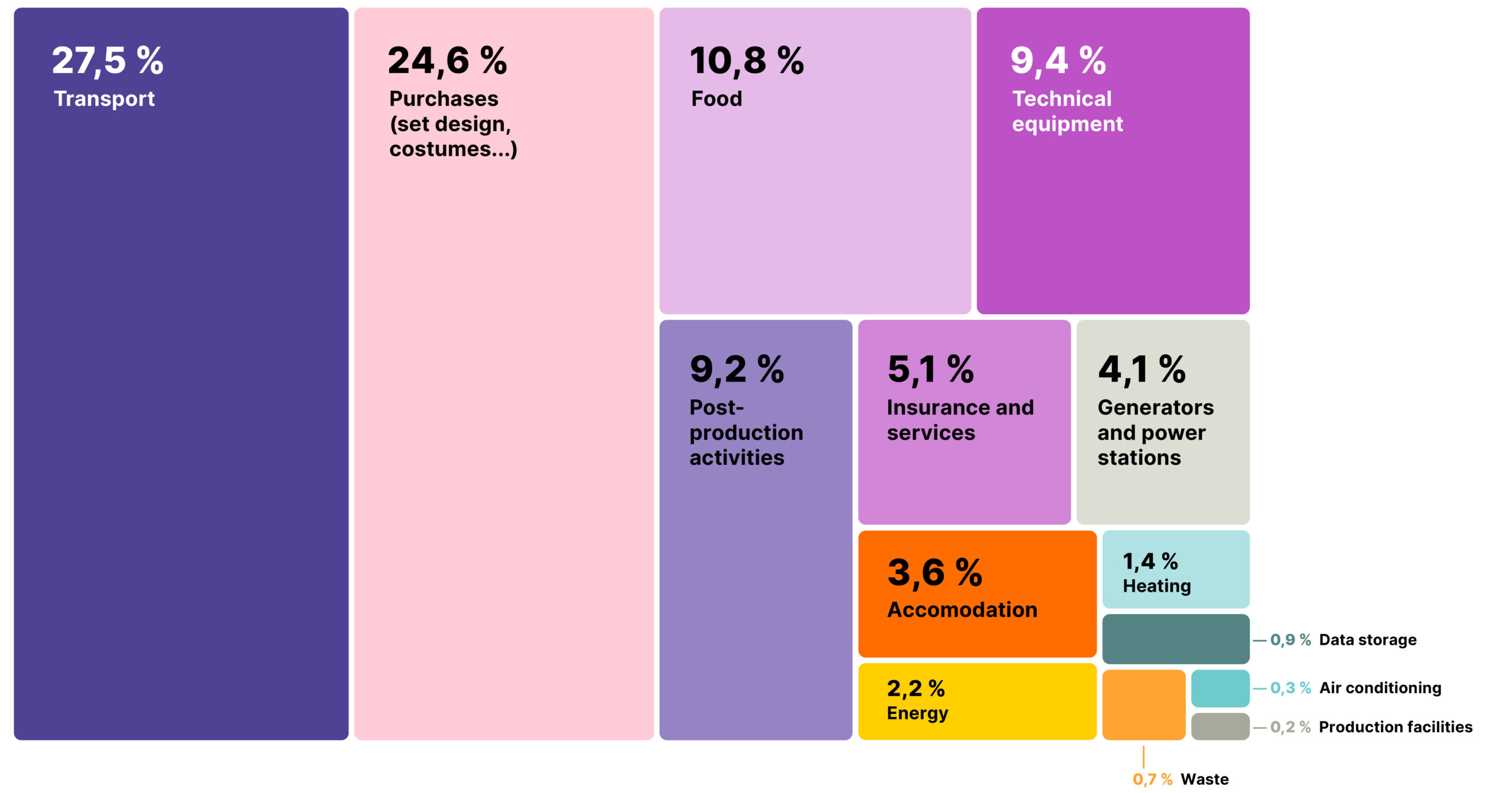
According to a study by Ecoprod, the main sources of emissions and key levers for decarbonization on a film set are transportation (27.5%), goods purchases (24.6%), and catering (10.8%).
It is therefore necessary to move toward new, sustainable models and practices. A film production is considered sustainable when it adopts an approach aimed at limiting its environmental impact. This approach applies at every stage of a film or audiovisual production’s life cycle, from writing to distribution.
Why Make the Shift to Sustainable Production?
Ensuring the Sector’s Long-Term Sustainability
In the face of a major environmental crisis and growing resource scarcity, the ecological transition of the industry is inevitable. It is therefore crucial to anticipate this shift rather than simply endure it.
Meeting Legal Compliance Requirements
Integrating sustainable practices into production processes helps ensure compliance with the growing number of environmental regulations, such as CSR Reporting, EU Carbon Footprint Reduction standards, CNC’s Eco-Conditionality, Regional Incentives…
Acting as a Role Model for Responsibility
The audiovisual industry bears a dual responsibility. Firstly, its central position and influence enable it to drive changes in public attitudes. Secondly, it can serve as a role model by triggering the ecological transition of many other sectors it interacts with (transportation, catering, energy, and more).
Seizing New Professional Opportunities
The rise of sustainable production, supported by public policies and institutions, encourages the emergence of new professions and offers existing teams the opportunity to develop specialized skills in the ecological transition of the sector.
Start your green production process with Ecoprod’s tools
ANTICIPATE
- Approach your project from an environmental perspective at the writing stage by analysing its impact from the first reading with the Script Breakdown Sustainability Checklist.
UNDERSTAND
- Calculate the (provisional and final) carbon footprint of your project with Carbon’Clap;
- Calculate the score of your project and identify areas for improvement based on the Ecoprod Label.
PLAN
- Contact AFNOR Certification to apply for the Ecoprod Label;
- Check your eligibility for financial support schemes.
ACT
- Use Ecoprod’s Guides and Practical Sheets to find suitable eco-responsible solutions for drawing up your project’s green production roadmap.
MOBILISE
- Implement your green production roadmap;
- Train with Ecoprod’s online training courses;
- Mobilise your teams (waste sorting, etc.) during filming.
PROMOTE
- Communicate about obtaining the Ecoprod Label and your green production process;
- Apply for the Ecoprod Award (at the Cannes Film Festival);
- Offset your project’s carbon emissions with the Eco-Production Forest (voluntary carbon contribution).
Sustainable Film Production in the World

Explore our free interactive map to discover green production regulations, financial incentives and tools around the world.


