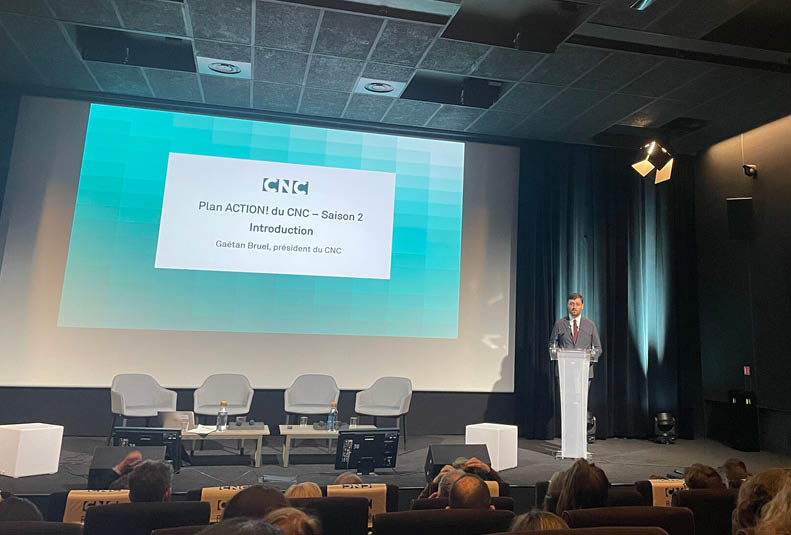
On March 11th 2025, the CNC (French National Film Fund) presented assessments and next steps for Plan Action!, its environmental transition roadmap for the film, audiovisual and technical industries.
Launched in 2021, Plan Action! includes three key initiatives:
- Measure the environmental impact of the industry through studies conducted by its Observatoire de la transition écologique (Observatory of Ecological Transition).
- Raise awareness among students and professionals about environmental issues and responsible production
- Structure the industry by making carbon calculation assessments mandatory to receive CNC’s funding (projected and final reports).
Insights from the first Plan Action ! (2021-2024)
Introduction speech by Gaëtan Bruel (President of the CNC)
Gaëtan Bruel, President of the CNC, opened the day with a speech highlighting the current, difficult, context regarding the environment: “This event takes place in a context that is not simple for our concerns. The ecological issue, the consideration of energy and environmental challenges, is progressing in small steps—so small that we sometimes wonder if we are merely standing still or even moving backward.”
Building on this observation, he emphasized the importance of cinema and storytelling: “If we want to fight the battle in the right place—that of representation and imagination—then we must make cinema and audiovisual media the primary grounds for raising awareness and fostering a quiet yet decisive revolution.”
He then reviewed the ecological transition efforts undertaken over the past four years by the CNC in collaboration with audiovisual stakeholders. These actions include conducting studies through the Ecological Transition Observatory, raising awareness among students and professionals through green production training, making production professionals aware of the impact of their activities, and structuring industry commitments through the Afnor Spec 2308 framework.
He also emphasized the CNC’s commitment to continuing on this proactive path, with announcements planned for 2025: “The Minister of Culture has asked the CNC to propose, by May, a boost for projects making the best efforts. Therefore, we are currently working on an incentive scheme linked to the Afnor framework.”
Gaëtan Bruel’s full speech can be accessed here (available in French only).
Ecological Transition Observatory: Key Trends
Cécile Lacoue, Director of Studies, Statistics, and Forecast, presented key industry trends identified by the Ecological Transition Observatory:
A Growing Commitment from Audiovisual Professionals: “Significant progress was made between 2022 and 2023: 87% of surveyed companies reported implementing environmental practices at the beginning of 2023, an increase of 9 percentage points compared to 2022.”
Motivations Often Driven by Financial and Regulatory Constraints: “The inflationary context is pushing a number of companies to take action and find ways to reduce their energy consumption. […] However, the motivations are diverse: there is also genuine commitment and increased awareness of CSR issues. […] Another key factor is future regulatory obligations: for example, the ‘tertiary decree,’ which requires cinemas with a surface area of more than 1,000m² to reduce their energy consumption by 40% by 2030 and 60% by 2050. […] The CNC’s green requirement for funding have also encouraged production companies to take action.”
Companies Committed to Reducing Their Carbon Footprint: “Many companies are still in the early stages, implementing relatively simple measures, such as waste management and recycling—though these are not necessarily the most impactful in terms of carbon footprint. […] However, 61% of companies reported optimizing their travel, likely driven by inflation. Half of them also mentioned prioritizing the purchase of environmentally friendly products.”
Budget as a Barrier to Environmental Action—But Less So Than Before: “Budget constraints remain a primary challenge, as there is a perception that the energy transition is costly. Time constraints and lack of information are also factors. […] However, what’s interesting and indicative of the sector’s maturity is that these barriers have diminished within a year—particularly in terms of time and information gaps. Companies are becoming more informed, and the energy transition is increasingly seen as a priority.”
Energy Assessment of Cinema Venues: “Newer venues consume significantly less energy, whereas much older venues—even after renovations—still tend to have high energy consumption. […] Venue size also plays a role: smaller establishments consume the least energy, while multiplexes consume the most. […] Projection, an inherent part of cinema operations, accounts for 16% of energy expenses. However, the majority of energy costs (nearly 60%) are attributed to heating, ventilation, and air conditioning. […] Various measures, ranging from simple to complex and costly, can be implemented—often with a quick return on investment. For example: replacing aging equipment, adjusting heating and air conditioning temperatures. However, for projection, only one major solution has been identified: replacing aging xenon projectors with energy-efficient laser projectors.”
Environmental Assessment of Film Studios: “The impact is significant: “92% of emissions are indirect, stemming from the productions hosted at these studios. […] While carbon impact varies by studio, they are mainly: the procurement and rental of goods and services, which together account for more than 80% of total carbon emissions. […] To mitigate their carbon footprint, studios can implement several measures, such as providing storage facilities for productions to reuse equipment, centralizing audiovisual hubs, maintaining a directory of local service providers and sustainable catering options, and setting up cargo bikes and charging stations for electric vehicles. […] More broadly, studios must rethink their operational models: ‘They need to be sustainably-designed, integrate renewable energy sources, and collaborate with producers, suppliers, and public authorities to develop collective solutions.'”
Read the full report of the Ecological transition observatory here (available in French only)
Next steps for the Observatoire de la transition écologique :
- Keep conducting environmental diagnosis
- Analyze the carbon assessment reports collected by the CNC
- Launch forecast analyses based on ADEME’s four transition scenarios
Training: a pivotal role
Agnès Toullieux (CNC’s deputy general secretary) and Frédéric Aublé (production manager and instructor) presented a first assessment of the green production training program followed by thousands of audiovisual students.
They specifically emphasized the need to avoid purely anxiety-inducing discourse and the importance of presenting concrete and effective action levers. They also highlighted the importance of continuous training for professionals, reminding them of the available programs across France. Explore the training courses offered by Ecoprod here.
CNC’s green production regulation
Leslie Thomas (CNC’s general secretary) presented the first results of the CNC’s green production regulation.
From 2021, productions wishing to get funding from the CNC have to provide both a projected and a final carbon assessment report by using the tools approved by the CNC (Carbon’Clap being one of them). Since March 1st 2025, this condition also applies to the animation and video game industry.
Close to 2000 carbon assessments have been completed since the introduction of this initiative (most of them being projected reports). They highlight a strong correlation between the cost of a production and its carbon impact (though there is also significant variability depending on the editorial genre). It is important to note that the results are based on projected data and vary depending on the tool used. This is why the CNC is working on updating the certification protocol for carbon footprint assessment tools.
Next steps (Plan Action ! 2025-2028)
Encouraging environmental and social commitment
After presenting the AFNOR SPEC 2308 (the responsible production framework established in 2024), Leslie Thomas announced that the CNC is considering the “implementation of financial support measures for productions making their best efforts”.
Look out for potential announcements at the 2025 Cannes Film Festival!
Environmental standards: a new opportunity for the industry?
Guest Speakers:
– Sébastien Saunier, director of strategy and credit, IFCIC (Institut pour le Financement du Cinéma et des Industries Culturelles)
– Livia Saurin, deputy general secretary, France Télévisions
– Mathilde Yagoubi, executive director, Game Only
Moderator: David Irle, green consultant, Le bureau des acclimatations
In the current context of increasing European regulations, companies in the tertiary sector must adapt to extra-financial reporting directives (CSRD, CS3D, SFDR).
For Mathilde Yagoubi, the reception of these regulations occurred in two stages. While their implementation has been long and difficult, their usefulness for the resilience and competitiveness of French companies is now becoming evident. According to her, France is “a driving force and a European leader on these issues.” While the measures remain incentivizing for the time being, this duty of transparency and rigor will become crucial for industry stakeholders. As Sébastien Saunier explained, conducting a carbon footprint assessment will be mandatory to secure a loan from the IFCIC by 2030.
Livia Saurin then presented France Télévisions’ extra-financial reporting strategy.
By bringing in an external party to help navigate these directives, the group aimed to identify concrete levers for reducing their environmental impact. Their greatest challenge is reducing their carbon footprint: 65% of it comes from device manufacturing (TVs, computers, tablets, smartphones…)—factors ‘beyond their control.’ As a result, the group chose to focus on direct actions, such as the green design of their france.tv website to minimize the impact of content consumption, as well as implementing key initiatives in their studios. Furthermore, France Télévisions launched an Internal Climate Convention with randomly selected employees and is developing an incentive-based CSR clause.
Livia Saurin acknowledges the power of channels like France Télévisions in setting a precedent for environmental responsibility. This role is reflected in their editorial choices: a threefold increase in environmental topics, the launch of a climate weather news, and an editor-in-chief dedicated to environmental issues. She also emphasized the importance of representing sustainable behaviors in their content. For example, the series Un si grand soleil regularly features characters sorting their waste, traveling by bike, and reflecting on environmental issues.
How to best support industry professionals?
While standards aim to guide all stakeholders toward a virtuous circle, it is necessary to offer specific support to small and medium-sized enterprises (SMEs). As Sébastien Saunier explains, budget remains a major barrier to environmental action, and financiers have an important role to play in the industry’s transition. The IFCIC, a public-interest mission institution, ties its investments to the environmental and CSR commitments of organizations applying for funding. While financiers bear responsibility, the speakers also emphasized the central role of public authorities as key drivers of the transition.
Standards: vectors of equity and stabilty
While the European Union has expanded the number of directives in recent years, the focus is now on ensuring their transposition across all member states to avoid a “two-speed Europe” (Mathilde Yagoubi). Indeed, many countries have yet to transpose them, creating imbalances and reducing the attractiveness of countries already implementing them.
For Mathilde Yagoubi, the standard should serve as a means of ensuring equity, and rather than multiplying directives (referencing the OMNIBUS package currently being discussed at the European Commission), the priority should be to transpose them and allow time for their effects to take hold.
Livia Saurin particularly emphasizes the need for stability in these complex issues to avoid losing professionals who are only just beginning to be engaged and trained. She cites the Afnor Spec 2308 framework, supported by the CNC, the DGMIC, and the Ecoprod Label: “The potential granting of public support in exchange for certification is something I find particularly interesting. […] Many environmental standards have emerged in the sector—Afnor Spec, Ecoprod… I would love to see an equivalence between the two. The acceptance of a standard comes with support, which the CNC and Ecoprod are doing very well. This support includes financial aid, but ideally also a reduction in administrative procedures to access and mobilize these resources. In this regard, convergence between the existing labels would be beneficial.”
She continues: “I believe there are synergies to be found between these different initiatives, which I see as more complementary than competitive. I strongly believe in co-creating solutions and in the role of public authorities in supporting this transition and properly recognizing virtuous initiatives.”
Towards an environmental transition of animation and VFX studios
The CNC published an audit assessing the environmental impact of animation, post-production, and VFX studios (available in French only). Highlighting the main emission sources, the audit also identifies levers for action to drive the sector’s transition.
Main emission sources:
- Energy
- Transportation
- Equipment and Services
- Waste
Taking action: recommendations aligned with Ecoprod’s Green Post Production Guide
Studios’ commitment to transition is supported by Ecoprod and its Green Post Production Guide (available in English soon). The 70 best practices outlined in the guide are crucial in reducing the industry’s environmental footprint, while enabling it to maintain its creativity and dynamism.
