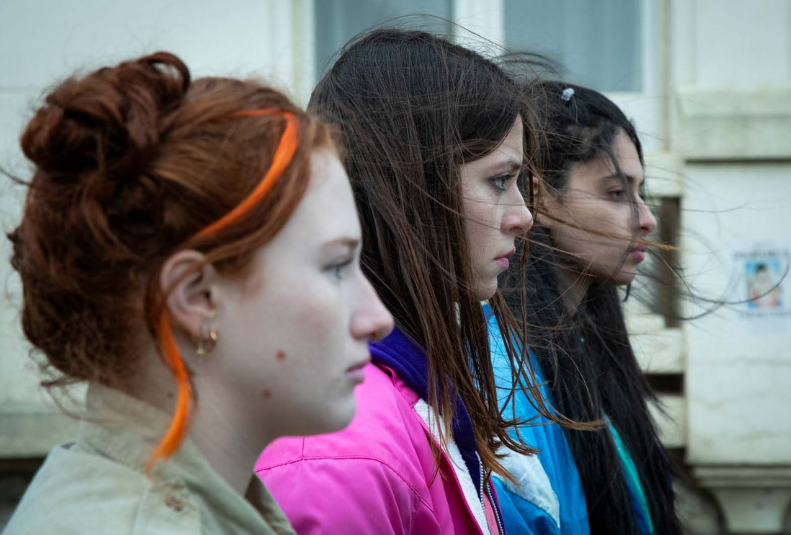
Ecoprod was delighted to speak with Bastien Larue, production manager for the series Désenchantées (produced by Banijay Studios France, broadcast on France 2), which has been awarded the Ecoprod 2-star label. Banijay Studios France is part of the Banijay Group, a member of Ecoprod.
What were the main green-production objectives defined from the outset for the series?
Every project has its own constraints and possibilities. There are common principles, but also specificities linked to the reality of the project at hand. For Désenchantées, we wanted to focus on reducing our carbon footprint in two areas in particular. The first concerns costumes and sets, as half of the series is set in 1999-2000, which requires careful consideration to minimise our needs, buy sustainably and give objects and clothing a second, or even a third, life (without compromising the artistic vision).
Secondly, regarding transport for the cast and crew, we were filming by the sea in Ault in the Somme, far from the main TGV lines: we had to convince the cast and ad-hoc crews to travel to the filming location whilst coping with the vagaries of regional rail services. This actually echoed our story, in which the main character, Fanny, arrives in Bouville-sur-mer on a TER train.
Filming in a natural environment
You filmed on the beaches and cliffs of Ault and Onival, located in the Somme region. How did you go about minimising the production’s impact on these natural environments?
Filming on the beaches and cliffs was supervised and inspected by the Somme’s DDTM (Departmental Directorate for Territories and the Sea), which imposes a strict but entirely necessary framework. We sometimes had to adapt the script (a fire on a sea wall rather than on the beach) or adjust our technical equipment (using a Steadicam rather than more intrusive devices). The use of drones was strictly regulated by the DDTM, and the team of pilots was chosen for their expertise in this field. I was also fortunate to work with a production manager, François Goursaud, a keen ornithologist, who was instrumental in managing the filming on the cliffs.
Incorporating animal welfare into the approach
You filmed with a dog: what specific measures were put in place to ensure its welfare?
We worked with Valérie Chavanon from Ciné-animal, who is highly skilled in her field and who ensured the animal’s welfare. It took a great deal of communication with the director to clarify his vision for the opening sequence of an episode and to adapt the shot list in line with the constraints set by the trainer. A rehearsal was organised the day before, without the technical crew or extras, allowing the animal to be gradually prepared for the demands of filming. On the production side, we ensured we followed Ciné-animal’s recommendations to guarantee the dog’s welfare, both beforehand (choice of accommodation) and on set. In this regard, the CAPA association has been established, and I am closely following their commitments.
Green post-production
Regarding post-production, what specific measures were put in place to reduce the project’s environmental footprint?
Post-production has a significant carbon footprint, which is less visible but nonetheless very real. We have therefore brought together the camera and post-production teams to establish a workflow that is both efficient and environmentally friendly (reducing the number of copies and hard drives, compressing files, archiving rushes on LTO tapes, etc.). However, we remain dependent on the requirements of broadcasters and streaming platforms.
For travel, having a DIT (Digital Image Technician) on set meant we didn’t have to transport the rushes to the lab straight away. These were transported by train, along with the rest of the crew, once or twice a week. Part of the post-production was carried out in Belgium (notably the sound effects), without requiring any additional travel by the teams.
Review of the green-production approach for Désenchantées
Was this the first time you had managed an Ecoprod certification application? What were the main lessons learnt from this first experience?
It was the first time I’d been responsible for a project’s Ecoprod certification, but I’m used to working on certified shoots. It’s a stimulating challenge to try to produce in the most environmentally friendly way possible. And we sense a genuine desire among the technicians and actors to adopt an approach that’s heading in the right direction.
