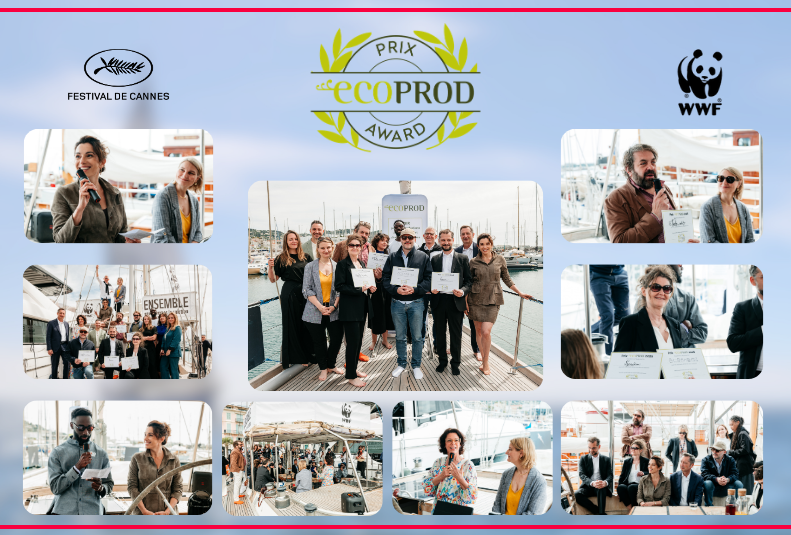
This Friday, May 15th, during the Cannes Film Festival, the Ecoprod Award was presented. For the past five years, the Ecoprod Award has highlighted the efforts of artists, productions, and technicians committed to reducing the environmental impact of their films. Given the exceptional quality of the submissions, the jury decided to award two prizes. The ceremony took place aboard the Blue Panda, the sailboat of WWF France, partner of the 5th edition of the Ecoprod Award.
Jean-Philippe Lefevre (Director of Community Engagement WWF France) : As partners, WWF France is honored to be part of this initiative because it doesn’t celebrate what we see on screen, but what happens behind the scenes: concrete actions and choices, a few compromises and a lot of innovation. We are convinced that the environmental transition is also taking place right here, on set and during filming. The film industry has a real impact on the world and the unique power to shape people’s imaginations. When it chooses to reduce the former in order to better nurture the latter, it is a gesture that matters.
The jury decided to honor two films
The Ecoprod Award goes to:
- All of a sudden directed by Ryūsuke Hamaguchi and produced by Cinéfrance Studios, Office Shirous and Bitters End, Heimat Films, Tarantula, Arte France, Same Player presented in the Official Selection.
A special mention was given to:
- Notre Salut [A man of his time] directed by Emmanuel Marre and produced by Kidam, Michigan Films, Condor Distribution, Les Films Pelléas, Unité, Les Films de Pierre, The Ink Connection, France 2 Cinéma, Orange Proximus, BeTV, RTBF presented in the Official Selection.
Chaired by Aure Atika (actress and writer), the jury was made up of Vincent Munier (documentary filmmaker and photographer), Mamadou Dembele (founder of Impact Story), Philip Boeffard (producer and co-founder of NORD-OUEST), Gwladys Bouillon-Pacheco (green production coordinator, co-founder of ACCEPTE), Clémentine Buren (impact producer LA PAC), Jean-Philippe Lefevre (WWF France), and Muriel Signouret (CSR Director SNCF). The jury decided to reward two feature films for their ambitious green production strategies.
Aure Atika: What struck me most is that the films that had the deepest environmental commitment, also demonstrated a different kind of human connection on set. It is as if environmental awareness also awakens a sense of community. Green production means rethinking how we make films without losing our passion, freedom, or artistic ambition. A film set is already a small community. When it becomes more responsible, it often becomes more humane as well.
Philip Boeffard (producer and co-founder of NORD-OUEST) : It’s fascinating to delve into these projects and see the scope of the work that’s been done; it speaks to a proactive and positive commitment. Each film has a specific production model that determines the constraints and parameters of its environmental approach. It’s inspiring because it’s not just about applying rules, but about developing a genuine strategy and approach capable of enhancing efficiency and making the message more impactful.
Gwladys Bouillin-Pacheco (green production coordinator) : As co-president of ACCEPTE, the professional association of green production coordinators, we are delighted to see the diversity of projects currently addressing environmental issues, combined with the high quality of the submissions. Green production is no longer a peripheral or passing trend: it has become a permanent part of the creative thinking and production practices, transcending all genres and budgets. In this regard, the Ecoprod Award plays an essential role by highlighting works that demonstrate it is possible to combine the artistic standards upheld by the Cannes selection with a genuine commitment to the environment.
Ewoprod Award: All of a Sudden
ALL OF A SUDDEN by Ryūsuke Hamaguchi, humanity as the cornerstone of the sustainability approach
The jury chose to give the Ecoprod Award to the film ALL OF A SUDDEN directed by Ryūsuke Hamaguchi, presented in the Official Selection. The jury wanted to highlight the commitment of the entire team in rising to the challenge of eco-friendly production within the framework of an international co-production.
Aure Atika : This award recognizes, above all, the human aspect of the production: the dedication of the director, the crew, and the partners, all united in bringing this vision to life. The team paid particular attention to caring for and respecting people, living things, and the environment, ensuring consistency between the story brought to the screen and the film’s production.
To implement the green production strategy, the producers hired a green production coordinator as early as the pre-preparation phase. His work, which began well in advance of filming and included an environmental assessment of the script, made it possible to anticipate likely environmental impacts. His presence throughout the preparation phase, then during filming and post-production, facilitated effective collaboration with the heads of all departments and with the crews.
Muriel Signouret (CSR Director SNCF) : By anticipating environmental impacts from the planning stage and developing a structured, cross-functional approach, the team behind ALL OF A SUDDEN succeeded in reducing its carbon emissions by 35%. This production demonstrates that it is possible to operate differently, even on large-scale international projects. The tools and processes implemented here can serve as a model for the entire industry: this is a true demonstration of foresight regarding the challenges of tomorrow.
In both France and Japan, filming locations were concentrated within a limited area to reduce travel and the need for vehicles, and to make them accessible via sustainable transportation. The set design team demonstrated great creativity by focusing on eco-friendly set design to ensure the sets aligned with the director’s vision while minimizing their environmental impact and allowing for reuse of assets for future productions. Some set elements remained in place; for example, the pergola built for the film still benefits the residents of the care facility today. For furnishings and props, 61% of purchases were made secondhand, with the majority of set elements and costumes also being rented.
During the preparation phase, Ryūsuke Hamaguchi required all department heads and interpreters to complete a three-day training course in “humanitude” (a care method aimed at supporting dependent individuals while respecting their dignity; it emphasizes the development of an empathetic and compassionate relationship between the caregiver and the person being cared for).
The jury highlighted the project’s coherence between its green production strategy and its consideration of living organisms and biodiversity.
ALL OF A SUDDEN also received two stars under the Ecoprod Label, validated by ADEME (French Agency for the Environment) and audited by Afnor Certification.
Synopsis : Director of a care facility for the elderly, Marie-Lou strives to introduce an innovative care philosophy based on listening and respecting residents’ dignity, despite resistance from part of her staff. Her encounter with Mari, a Japanese theater director battling cancer, will profoundly reshape her path. By forming a deep, supportive friendship, the two women join forces in a shared struggle to “make the impossible possible.”
Special Mention: Notre Salut [A man of his time]
A MAN OF HIS TIME by Emmanuel Marre, a period film that turns constraints into strengths
The jury awarded a Special Mention to the film A MAN OF HIS TIME, directed by Emmanuel Marre, produced by Kidam and Michigan Films, and selected for the Official Competition at the Cannes Film Festival.
Swann Arlaud: We made this film with a small team, in a flat hierarchy, filled with energy, joy, and a sense of camaraderie. Emmanuel Marre’s approach was to keep things as simple as possible (in terms of equipment, team, and travel) and to work with natural light. For the sake of authenticity and restraint. Because he seeks documentary material that is as close to reality as possible, and because freedom is often found in the economy of means. At no point did we feel this was a constraint – quite the opposite.
For the filming of this period piece (set in the 1940s), it was decided not to build elaborate sets for the reenactments, in order to avoid constructing large structures that would require a significant amount of raw materials.
To achieve this, extensive location scouting was conducted at historic sites. The production team made maximum use of natural settings, adding period props. The direction was adapted to this constraint by opting for close-up shots whenever possible to avoid having to set up too many surrounding props (particularly cars on the streets).
From the very start of the project, the goal was to be as minimalist as possible. The production team limited the use of technical equipment, which is often very energy-intensive. This frugal approach became a source of creativity. The team successfully turned it into a narrative and visual asset.
Post-production, identified as a carbon-intensive phase of the project (nearly 40% of the total carbon footprint), was the focus of special attention: limiting travel through remote work, optimizing digital data storage, and streamlining technical resources.
Clémentine Buren (impact producer La Pac) : Creativity thrives on constraints: A MAN OF HIS TIME proves that a period film can serve as a lesson in green production!
The entire crew was fully engaged at every level. It’s also worth noting that red meat was completely excluded to reduce the carbon footprint associated with food. The production team chose a committed caterer that prioritized local, seasonal, and predominantly vegetarian ingredients.
Synopsis : September 1940. Henri Marre arrives alone in Vichy as the authoritarian regime settles in. Broke, estranged from his family, and carrying copies of his self-published manifesto Notre Salut (Our Salvation), the 49-year-old is determined to secure what he believes is his rightful place in the new administration. In his writing, Henri sets out his patriotic convictions and his engineer’s methodology: efficiency above all. Claiming he wants to help save France after defeat, he does whatever is required to remain useful, serving the machinery of the new order with increasing skill. But he may be pursuing something more urgent: escape from his own ruin.
