From March 5th to March 9th, Paris hosted the inaugural French Nordic Film Days, a dual event combining a Nordic film festival with a French-Nordic industry forum. The first three days (March 5th-7th) focused on industry discussions, with panels and case studies addressing sustainability and green production—a growing priority for European cinema.
Panel I – Sustainability, everybody on deck!
Panelists:
– Patrik Axén: Production Controller and Sustainability Coordinator, Swedish Film Institute
– Agnès Toullieux: Deputy General Secretary, CNC
Moderator:
– Daphné Lora: Head of Film France and Game France, CNC
Green Production Initiatives in France
Agnès Toullieux opened the panel by giving a broad overview of the CNC’s sustainability strategy.
2022 was “all about incentives”, as the CNC started conducting industry-wide surveys about green practices, as well as implementing (voluntary) sustainability training programs in film schools. 2023 was the year of “defining clear rules regarding carbon footprint assessment”, with the implementation of the CNC’s green production regulation.
The CNC is currently increasing its effort with the development of Afnor Spec 2308 – Responsible film, audiovisual and advertising production. Its strategy is to pursue a progressive policy scheme, which is built alongside social partners, film professionals, and public authorities.
The CNC release its new action plan on Tuesday, March 11th.
Green Production Initiatives in the Nordics
Patrik Axén likened filmmaking to “society on steroids”, a resource-intensive process requiring urgent adaptation. He then introduced The Five Nordics (which brings together the Danish Film Institute, the Finnish Film Foundation, the Icelandic Film Centre, the Norwegian Film Institute and the Swedish Film Institute), an organisation working on establishing the Nordics Ecological Standard (NES), “a cross-border system defining clear standards for sustainable production”.
As Axén explained, the Nordic countries first worked individually on the challenge of sustainable production. There were many different initiatives, implemented at different times, and going in different directions. For example, Finland (a pioneer when it comes to sustainable production) started working with the Albert calculator, while Denmark and Norway launched the Green Film Initiative. Overall, actions were not organised or coordinated, and there was a clear need for harmonisation within the neighbouring countries.
The Five Nordics thus decided to start working together to tackle the issue of sustainable production. To develop their strategy, they relied on the expertise of other countries (i.e Germany with the German Ecological Standard). The idea to create a common standard for all Nordic countries emerged shortly after.
With the help of The Footprint Firm – a Danish consulting firm with a strong focus on sustainability – they imagined a set of rules and action points for (more) sustainable production.
As it currently stands, the Nordic Ecological Standards (NES) includes the following principles and features:
- It offers a unique set of sustainability standards for all Nordic countries
- It can be adapted to different formats (feature films, series, documentaries…)
- It makes it mandatory to hire a green consultant / a sustainability coordinator
- It forbids flying when a trip takes less than 5 hours by train
- It features a set of non-mandatory requirements (including biodiversity)
- It allows for 5 deviations
As Axén explained, there are a lot of co-productions between the Nordics already. Therefore, creating a common standard would help streamline procedures and workflows between the five countries.
The Five Nordics are currently in the process of circulating a new version of the draft of the NES. Their goal is to launch the initiative on a voluntary basis this spring, and to hopefully make the standard mandatory by next fall. Keep an eye out for this initiative!
What does the future hold for sustainable production?
According to Patrik Axén, the industry is not only ready for but demands a green transition. As more financial incentives to produce sustainability are emerging (see the Austrian Film Institute’s incentive model for film production here), and as implementing an ambitious sustainability strategy is becoming a key requirement to obtain public funding (CNC, Eurimages, Creative Europe…), green production will be a key tool to sustain the industry’s competitiveness and resilience.
Axén reassured industry professionals that adopting green standards is less daunting than it seems:
- Requirements can be gradually introduced within each department (production, post-production, lighting, costume design).
- Sustainability consultants will soon become a standard production cost, just like intimacy coordinators, which were rare a few years ago but are now essential for certain scenes.
- While green production may require higher upfront costs, long-term savings (e.g., reusing costumes, switching to energy-efficient lighting) will reduce expenses over time.
To support this transition, training and resources are key. Initiatives like StepUP, the online platform dedicated to sustainable practices in the film industry, provide professionals with specialized courses, practical guidelines, and real-world case studies to help integrate green production strategies efficiently.
To conclude, Axén emphasized the need for greater European collaboration, calling on the European Commission to establish a harmonized framework across EU member states.
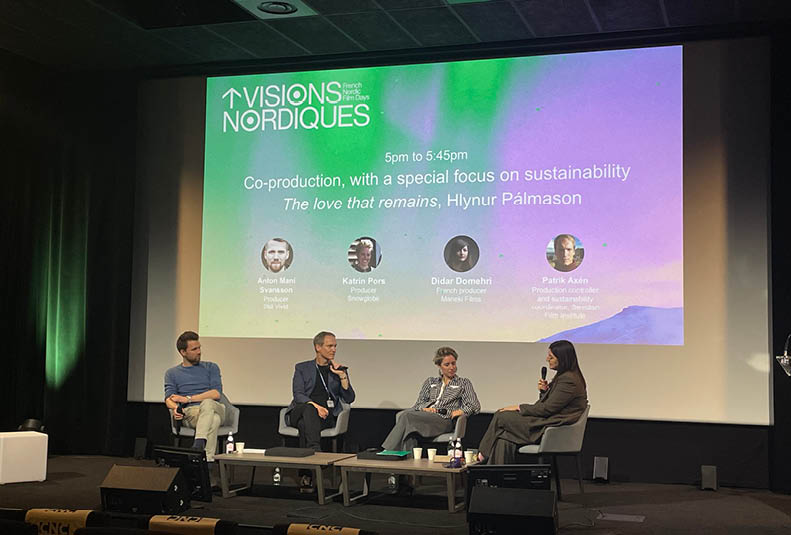
Panel II – Co-production, with a special focus on sustainability
Case study: The Love that Remains, Hlynur Pálmason
Panelists:
– Anton Mani Svansson: Producer (Still Vivid)
– Katrin Pors: Producer (Snowglobe)
– Didar Domehri: Producer (Maneki Films)
– Patrik Axén: Production Controller and Sustainability Coordinator (Swedish Film Institute)
An environmentally and “humanly sustainable” approach
After a presentation of the panelists and of their production companies, the audience got to watch a five-minute preview of The love that remains, Hlynur Pálmason’s upcoming film.
As Pors explained, this movie was not only environmentally responsible but also “humanly sustainable”. The director and crew have been working together since film school, and there is a strong sense of community among the team. For this film, the crew got to bring their family and lived with them in shared apartments and houses. Furthermore, the shooting schedule was extended to allow both cast and crew to spend more time with their family.
As Svansson added, “people are way happier when they live in a community”. Living in shared accommodations also allowed for better working conditions. For example, Svansson explained that the costume designer had “better facilities” as there was a dedicated laundry room in the shared apartments.
As Pors explained, the cast and crew living in Iceland and in other parts of Scandinavia, have a deep relationship to nature : “We are constantly surrounded by nature and we see it change from year to year”. This shared appreciation for nature was reflected in the production choices. No generators were used on set, there were no “trailers of fancy hotel rooms” (Svansson), the team and director attended workshops, costume designers either rented the costumes or sourced them from local second-hand stores, the materials used for set design (i.e wood) came from previous movie sets… Sustainability is also deeply rooted in the creative approach of the director, who prefers to work with natural lights. As Pors summed up, directors “need to be a part of this global thinking, and sustainability needs to start with writing”.
In terms of food, the production hired a chef who solely prepared vegan or vegetarian meals. As Pors explains, “you can have vegetarian catering everyday without realizing it”. Twice a week, the team hosted a “leftover evening” in order to reduce food waste as much as possible. Moreover, there was no craft table. The crew and cast had three meals a day, that’s all.
Svansson continued the conversation by explaining that the companies involved in this co-production want to be “front runners in the change that’s about to come”. As he explained, the goal is “To do a little bit more with every project, as you learn to reduce your impact with every production you get to work on”. He also mentioned the role that sustainability plays when it comes to obtaining public funding: as a production company, showing that you are thinking about your sustainability strategy during the pre-production stage is a “big plus” for funding applications. Hiring a green consultant / sustainability coordinator in the early stages of production helps identify carbon emission posts and helps cut production costs. As he sums up, “it is a true win/win situation”.
Challenges and Limits of Co-Productions
The production team was candid about the challenges they faced in this co-production, the biggest one being transportation (accounting for over 60% of their total carbon footprint). While they tried to hire as many locals as they could, a lot of flights were taken because the shoot was in such a remote location. Because this film is a co-production, the team came from various countries and it wasn’t always possible to use sustainable modes of transportation. For example, the crew members coming from Copenhagen had to take a three-day long ferry ride in order to reach the location shoot in Iceland. Consequently, a lot of planes were taken and their biggest emission post was transport (accounting for more than 60% of their total carbon footprint). Whenever it was possible, crew members favoured more sustainable means of transportation. While on location, the cast and crew carpooled.
This assessment also raised a larger issue regarding the future of co-productions. While they are a great way to learn from each other, discover better practices and share insights, “they are, by nature, not sustainable”. (Domehri).
The production team worked with Green Producers Club to implement its sustainable production strategy.
