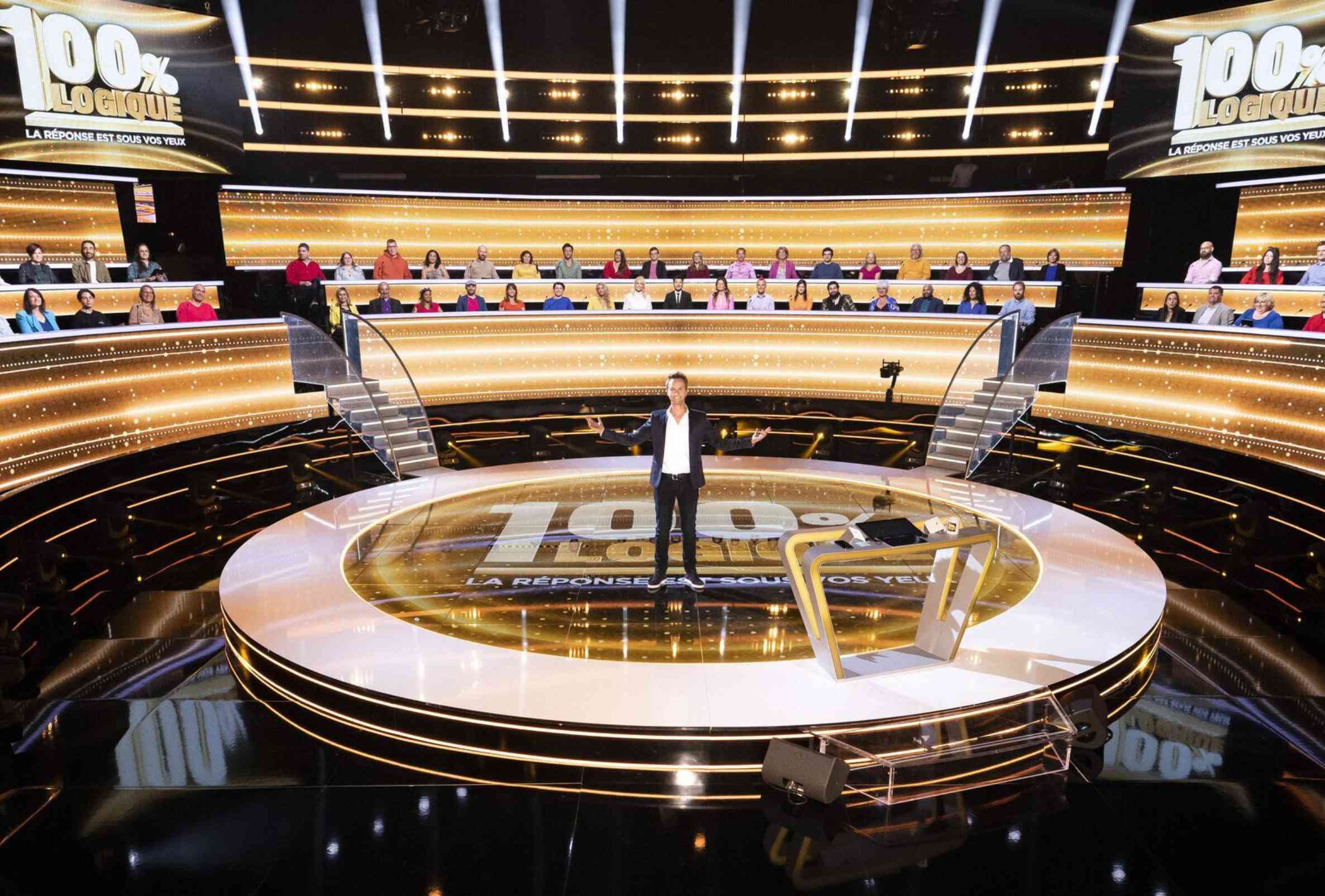
Ecoprod was delighted to speak with Laurine Vaccaro from A Better Prod, the Impact Manager on the set of the programme 100% Logique (Ecoprod 3-star label), produced by BBC Studios France.
Training department heads in green-production, environmental impact assessments, reducing transport impacts, a bulk catering system: take a look behind the scenes of an green-produced programme!
A 3-star Ecoprod Label achieved with flying colours!
You’ve achieved 3 stars and an exemplary score for the Label: what was your approach to achieving this?
We were lucky enough to be approached very early on, in June 2024, for filming in December 2024 and March 2025, on the initiative of BBC Studios France and at the request of the broadcaster France Télévisions. I was able to run a training session right from the start with the key department heads. Looking back, it seemed essential to me because it meant they understood why we were implementing these measures. It’s not just a matter of bonuses or ticking boxes, as some might think. Once we explain, break down preconceptions and get involved, the teams buy into the approach much more readily. And then, on a personal level, it’s also much nicer to arrive on set where people know me, trust me and become ambassadors for green-production themselves. I truly believe that the training beforehand and forward planning were the cornerstones of this success.
Were there any initiatives already in place when you arrived? Were you able to build on previous experience or the stability of the teams?
The BBC team was already very stable and committed. Jeremie Gougeon, then Head of Production, had already initiated the process with the Production Administrator, Dionne Nguyen. Key figures, such as production manager Betty Rousseau, became real pillars of the project and recognised the value of the Label in bringing the initiative to fruition. The editorial and post-production teams have remained the same since the programme began; they had already implemented numerous measures within their respective roles and saw the certification process as a new challenge to tackle.
You conduct a face-to-face review of the actions at the end of the project. What does this bring to the team?
For me, it’s the best part! It’s factual, and everyone realises the real impact of our actions. I explain, for example, the concept of CO2 equivalent using slides and concrete, fun comparisons! This presentation really makes an impression and allows everyone to identify the successes and progress made.
During the debrief, we detail the main areas of impact, particularly transport, due to the movement of sets, equipment and teams. This summary is always conducted in person. It is now an integral part of our DNA at A Better Prod.
On a shoot, it can happen that some crew members only remember what they have seen for themselves – often just a tiny fraction of the actions taken – and are not necessarily aware of how effective the approach is. Hence the importance of this debriefing, at least with the department heads, and ideally with the whole crew.
Both editorial criteria for the Label have been validated!
How to approach the Ecoprod Label’s editorial criteria often raises questions for live broadcasts. How did you meet this requirement for this game show?
The environmental review was carried out with different people at various stages of the project. I first met with the production team to define the editorial framework and the scope we had. Then I met with the editorial team responsible for the questions, the graphics and everything related to the programme’s content. It is important to note that, in this game show, all the questions the contestants answer must be based exclusively on logic: there are strict rules, monitored by a bailiff.
The editorial team can then adapt these scenarios to promote more responsible and inclusive practices, such as cyclists rather than cars, inclusive first names, a gay couple, the term ‘eco-friendly’, wind turbines, a person with a disability, diverse backgrounds and ethnicities, solar panels, waste sorting, the train, or even a holidaymaker travelling by bike!
Was the team already aware of these issues?
The 100% Logique team was already quite aware of environmental and inclusion issues, and was working towards these goals. On the editorial side, my role was to promote this editorial work, particularly to the rest of the team, through the eco-notes. These eco-notes are short (and often light-hearted) updates on our approach, shared via the staff newsletter to let the whole team know what everyone is doing!
In short, everyone was on board, which allowed us to pursue other criteria for the Label that hadn’t yet been met.
Furthermore, I believe that inclusive and gender-balanced casting is part of editorial awareness. The casting director provided me with the full list of candidates since Season 1: with the exception of two people, gender parity was perfect; only last-minute withdrawals prevented total balance.
When it comes to inclusion, subtitles enable 7 million deaf or hard-of-hearing people to access the programme.
Finally, Cyril Féraud, the presenter, is also very respectful and inclusive, which creates an atmosphere where everyone feels valued and welcome.
What is your approach to this type of project?
I take a step-by-step approach, without rushing people, to ensure the changes are sustainable. That’s what we always emphasise in training: stay positive, move forward gradually, and embed best practices for the long term.
A major success in transport management
What has been your greatest achievement in this programme?
My greatest achievement was meeting the requirement to reduce transport-related emissions. The set scenery is stored in Portugal all year round, and initially it was due to make four return journeys over the season, to be used during the two filming periods of the year. Four return journeys with three articulated lorries amounts to around 6 tonnes of CO₂! If there was one area where we could make savings on transport-related emissions, this was it! In practice, it was less straightforward. I really nearly gave up, as it was a real change of habit for everyone, and it also meant a definite loss of income for the Portuguese service provider.
The Label really challenged and mobilised us on this transport issue, and we managed to halve the impact of these journeys. To meet this criterion of the Label, we had to find a turnkey solution to propose to the production team. I looked for a storage facility in the Île-de-France region capable of holding all the set pieces between the two shoots, which wasn’t easy. After numerous calls, a service provider specialising in vehicle storage agreed. I prepared everything to make the production team’s decision easier, and in the end, they agreed to give it a go.
In the end, we were able to count on everyone’s cooperation: Cenyset in Portugal, Marchal Technologies in the Île-de-France region, the stage manager, and above all Betty, the project manager, who anticipated any potential issues and resolved them.
AMP was also a great help. The 100 chairs used by the contestants on 100% Logique are also used on the programme Dancing with the Stars. We couldn’t ask DALS to make an extra trip to collect their chairs from our storage facility. They were able to be stored at AMP for the month between the two filming sessions for 100% Logique and DALS, thanks to a collective coordination effort.
Although storage in the Île-de-France region is more expensive, over three months this was offset by the savings on transport. Building on this experience, Cenyset is considering setting up a storage facility in the Île-de-France region: it too has every interest in moving in this direction, for its own CSR commitments as well as those of its clients.
Were you able to draw on your previous experience?
Yes, although every project is unique, I was able to draw on my previous experience, particularly from my other projects bearing the ‘Hot Ones’, ‘Euromillions’ and ‘Loto’ labels. This allowed me to feel confident with the Label’s criteria and to adapt the approach as the project progressed.
In your opinion, what areas need improvement?
There is still room for improvement; for example, there were still a few flights involved. For the programme, two contestants came from abroad. Even though the production team did not cover the cost of their tickets, we chose to include all flights in the carbon footprint calculation, in the interests of transparency.
When it came to purchasing props, we managed to prioritise French companies during the second filming session, but the pace of production doesn’t always allow for this. The certification process, with its commitment phase, helps us move forward and raise awareness among the teams in the long term. Once we’d obtained the Commitment Label, the goal was to achieve three stars!
Avoiding single-use individual containers
There is another criterion of the Label that can be challenging for programmes with a live audience: the drastic reduction in single-use individual containers (criterion I6 of the Ecoprod Label). How did you manage catering for the contestants and the programme’s audience, particularly with regard to food and water?
This is an area we’ve worked hard on, as the traditional pack of triangular sandwiches for the public or contestants always poses a problem, with a lot of disposable packaging. For drinks, we considered every option, until we thought we’d found the ideal solution: the ‘vegan bottle’, a biodegradable bottle! But after consulting our waste management provider, Fin2déchets, we discovered that these bottles were not accepted in the organic waste bin…
So we had to choose between a vegan bottle that would end up in the general waste bin, and a standard plastic bottle, which is recyclable and will have a second life. Shows with a live audience present a real challenge when it comes to limiting disposable containers. The audience and contestants spend several hours on set, so we need to provide them with water without resorting to disposables. Cups and cans can tip over, glass is heavy, noisy and can break. That leaves Tetra Pak and plastic bottles.
We tested Tetra Pak, but here too, recycling poses a problem. Our service provider, Fin2déchets, has confirmed that there are very few plants in France capable of recycling Tetra Pak, which means long transport distances and the need to reach a certain volume for it to be cost-effective. It ultimately seems that the plastic bottle, because it is made of a single material with more accessible recycling channels, remains the simplest solution to recycle in this specific case.
Eau Neuve also told us about resealable aluminium bottles, which are recyclable and made of a single material, but they are heavier and more expensive. Once used, they are remelted to make sheets for the aerospace industry, but this remains a costly solution.
In the end, we used Tetra Paks only on request, installed numerous water fountains and clearly indicated everywhere that people should bring their own water bottles. Fortunately, on our programme, the contestants were allowed to bring their own water bottles, which isn’t always the case elsewhere. Once again, I was able to rely on the casting director and his team, who were very committed and did a great job of passing on the information to the contestants.
The real victory on this shoot, in terms of reducing plastic, was removing the water bottle from the lunch box, which encouraged the audience to bring their own water bottles.
And what about the food? Have you managed to reduce packaging or offer more sustainable alternatives?
As for the food, we’ve switched from triangular sandwiches to homemade ones: a vegetarian option, and one with chicken or fish, all wrapped in paper.
When I arrived, the packed lunch also included an over-packaged cake, a pot of fruit purée and a packet of crisps. We met with the canteen manager (L’Entract), the caterer supplying the control room (Crem’O Da) and the stage manager Samuel Fermino to discuss the best possible contents for this lunchbox. We replaced the tinned fruit with seasonal fruit: apples and clementines in December, and we kept the bananas, which are difficult to replace. The cake was removed. In the contestants’ area, the production team’s table, like that of the technicians, consisted of loose items (madeleines, cakes, peanuts, etc.). It was agreed that the biscuits on the production team’s table would suffice. Finally, for the crisps, we looked for alternatives: paper packaging does exist, but it is rare and we could only find one British brand. We ultimately opted for a brand made in France: we lost the paper packaging, but we avoided transport!
To get started with eco-production, check out Ecoprod’s resources and training courses.
