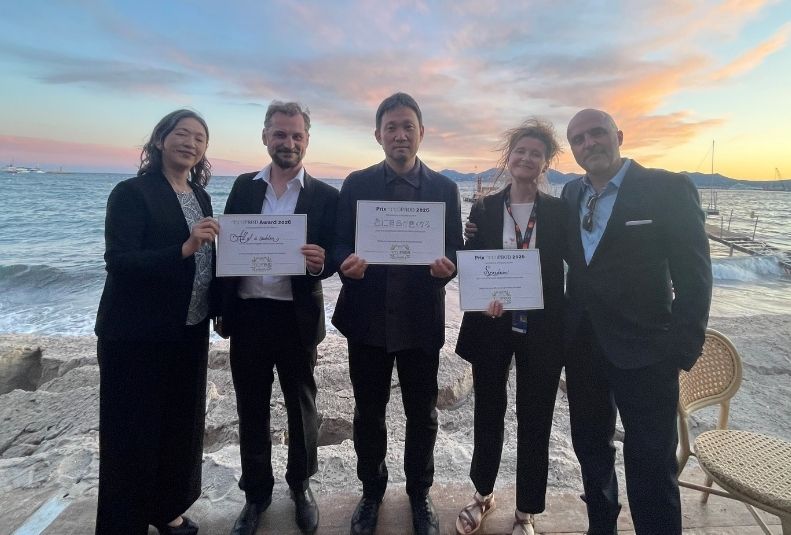
I am deeply honored that All of a sudden received the Ecoprod Award here. I would also like to express my heartfelt gratitude and respect to our team, whose actions on the ground made this recognition possible.
When we speak of eco-production, what often comes to mind is reducing paper use, cutting CO₂ emissions, and minimizing waste. But for me, what matters most is the “environment” of labor itself — work that occupies the greater part of people’s lives.
Approximately 90% of this film was shot in France, and achieving the high standards of eco-production would have been impossible without the well-structured labor conditions that France provides. Limits on overtime and a two-day weekend are built into the production process by law and by collective agreement. This may seem a matter of course to people in France, but as someone familiar with the production environment in Japan, I know it is anything but. Without such safeguards, employers will inevitably seek to have their employees work as long and as cheaply as possible — a reality that transcends national borders and industries alike. I came to understand that the consideration for human beings embedded in our production environment is the hard-won result of relentless negotiation by those who work in France’s cultural and film industries. I also felt, firsthand, that this is precisely what continues to guarantee the sustainability and high quality of French cinema. I offer my deepest respect to that history.
Our film depicts a shortage of workers in the care industry and a director struggling with that reality. For me, it is also a reflection of the challenges facing the Japanese film industry. I am now wrestling with the question of how to work with cast and crew — especially young people — while truly respecting them as human beings. I find a hint of an answer in the care technique called “Humanitude,” which we adopted in this film: the ability to assess a structure clearly, to distinguish what can be changed from what cannot — to tell the difference, so to speak, between powerlessness and limited power — and to find, even within that limited power, the points where change is possible. The efforts of the characters in this film mirror our own real-world trials and errors. It means a great deal to us that this film has been recognized from the perspective of eco-production as well.
Please forgive me if I close by voicing a concern related to the working environment. As you know, the development of AI in recent years has been remarkable, and it is already beginning to permeate the details of our daily lives. There is no doubt that it makes certain aspects of our work easier (Incidentally, this speech was translated with the help of AI!!).
At the same time, when the time saved by AI is absorbed directly into production schedules, it is clear that AI’s overwhelming speed will leave our bodies behind. Communicating so that human beings can understand one another, allowing our bodies to recover, and developing skills — all of these necessarily take time. That is what it means for human beings to work with other human beings. Alienating people from an industry in order to keep pace with the speed of technology will lead to the death of the industry itself, because both those who make and those who receive can only ever be human. To ensure that this foundation is not lost, we must protect working conditions that are suited to our physical reality as human beings. France has a history in which, at the rise of the television industry, filmmakers established the concept of “cultural exception” — the idea that culture, carrying language, history, and values, cannot be measured by market logic alone. If we wish to avoid a situation in which surrendering to market forces alone diminishes human values themselves, I believe there is much we can learn from that history.
I hope that the opportunity to collaborate with YOU across borders will continue for a long time to come. Thank you so very much for the Ecoprod Award.
Ryusuke Hamaguchi
